3 things most business owners don't notice about their software
Your software affects your business in ways you may not notice: disconnected tools make information harder to trust, how data is organised limits the questions you can ask, and today's fit won't last.
Business owners usually think about their software when it breaks, or when a renewal invoice arrives. In between, it fades into the background. But software shapes how a business works every day, in three ways that are easy to miss.
1. Disconnected tools make information harder to trust
When the same information lives in several tools, each copy drifts. Sales has one total, accounts another, the dashboard a third, and the last email said "about forty thousand". Each is right by its own lights; none can be trusted on its own.
The cost isn't only the time spent reconciling. It is decisions delayed, or made on the number that happened to be at hand.
Worth checking: pick one important figure, such as this month's sales, and ask three people where they would find it. If you get three answers, the tools are disconnected.
2. The way information is organised affects the decisions people can make
You can only ask questions the data can answer. If sales are recorded without the site, you can't compare sites. If bookings aren't linked to customers, you can't see who your best customers are. If costs aren't linked to projects, you can't tell which projects pay.
These limits are invisible, because nobody asks a question they know can't be answered.
Worth checking: list the five questions you would most like answered about the business, and see whether your data, as it is organised today, could answer them.
3. A process that works today may need to change as the business grows
Software is set up for the business as it was at the time. The business moves on: more staff, new services, new rules. Workarounds appear one at a time, and each seems minor.
Worth checking: ask the team which things they do outside the system, and why. Each answer is a place where the software no longer fits the process.
Process, information, decision
Review whether your systems still support the way your business operates. Process shapes information, and information shapes decisions. A review every year or two, asking the three questions above, is a small investment. No single platform solves every issue, but knowing where the gaps are is the first step.
Where Parsware fits
Parsware builds applications around a business's own information and processes. Tables organise information so that it can answer the questions you care about, forms and processes follow your own steps, and reports are drawn on a canvas. AI is built into the designers, and we build custom mobile apps for iOS and Android.
Here is information organised around questions in our Sports & Leisure sample application, a fictional leisure business (sample data, not a customer). Its reports are grouped by what people ask about: memberships, bookings, money and customers:
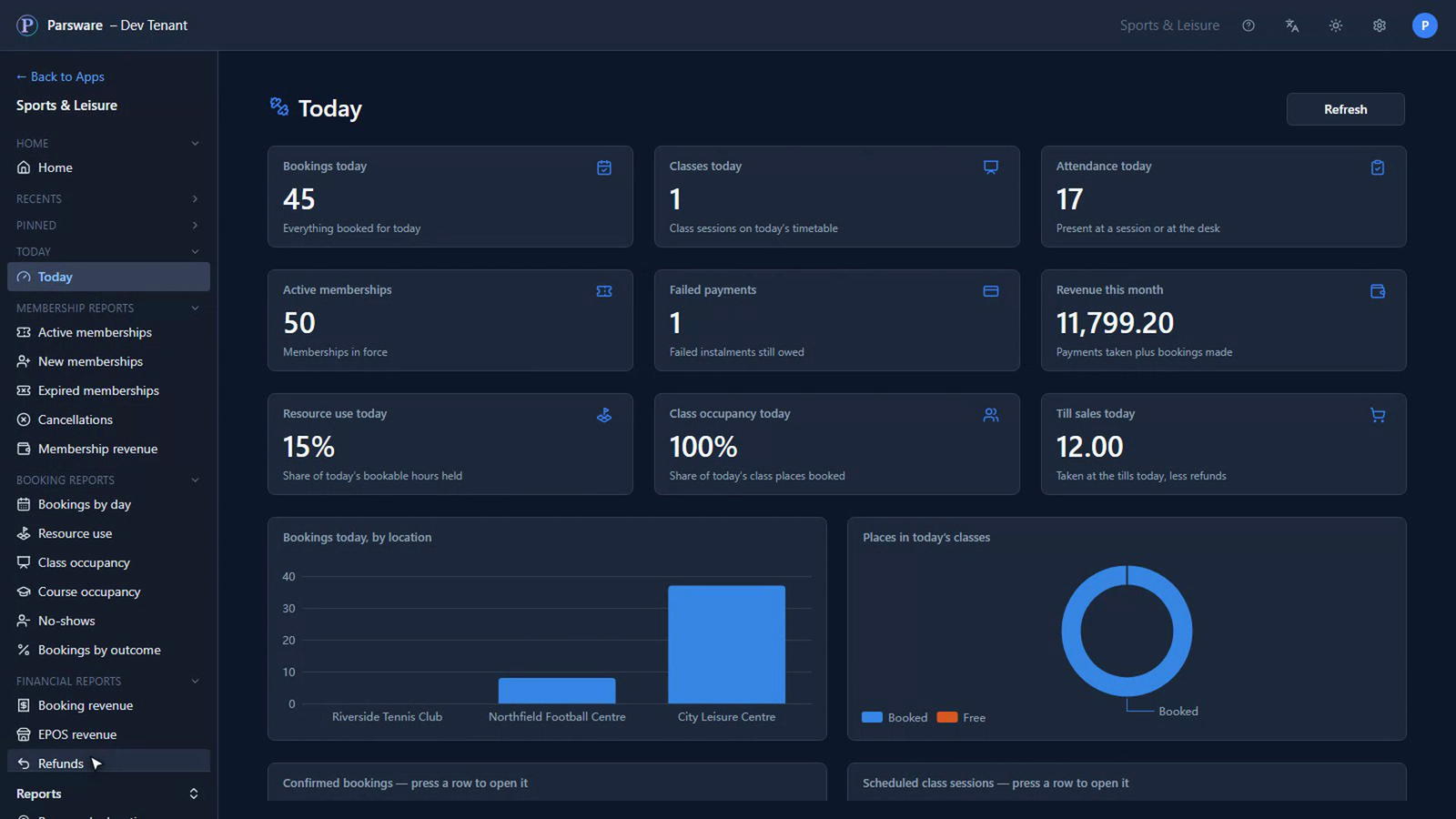
The reports and the Today page are in Know how today is going, before you ask.
When did you last review whether your software still fits your business? And if it has a problem nobody has solved yet, tell us about it.