3 things to check before paying for custom software
Before signing a custom software contract, check who owns and can access your data, what support and changes will cost, and how the software will adapt when your processes change.
Custom software can be exactly the right choice: built for your business, doing what nothing on the shelf does. But a custom software contract is not a one-off purchase. It is the start of a long relationship, and the contract decides how that relationship goes.
Three things are worth checking before you sign.
1. Who owns and can access your business data?
Your customers, orders, prices and history are among the most valuable things the business has. The contract should say plainly that the data is yours, and how you can get it.
Ask: where is the data stored? Can we get all of it out, in a usable form, at any time, without paying extra? What happens to it if we end the contract, or the supplier stops trading? Who else can see it?
2. What are the ongoing support and change costs?
The build price is the visible number. Then come support fees, hosting, updates, and the cost of every change the business will need: a new field, a new report, a new rule.
Ask: what does support cost each year, and what does it include? How is a small change priced, and how long does one usually take? Are updates to keep the software secure and working included? Ask for examples from existing customers, not just a rate card.
3. How will the software adapt when your processes change?
Your processes will change. A new approval limit, a new branch, a new regulation. In some custom software those changes are settings; in others each one is a project.
Ask: which parts can we change ourselves? Which need the supplier? If the supplier is unavailable, can someone else maintain it, and is the code and documentation ours?
A long relationship
Understand the long-term relationship and responsibilities, not only the initial delivery. A good custom software supplier will welcome these questions, because the answers protect both sides.
Where Parsware fits
Building on a platform is an alternative worth comparing with a fully bespoke project. It is not always the cheaper one; it depends on the problem. With Parsware, forms, processes and reports are built in designers, so many changes are edits rather than development, and the data lives in your own tables. AI is built into the designers, and we build custom mobile apps for iOS and Android.
Here is your data on the record in our Organisation sample application, a fictional organisation's structure (sample data, not a customer). Every approval and every return on an organisational change is kept on the order itself, with who decided and when:
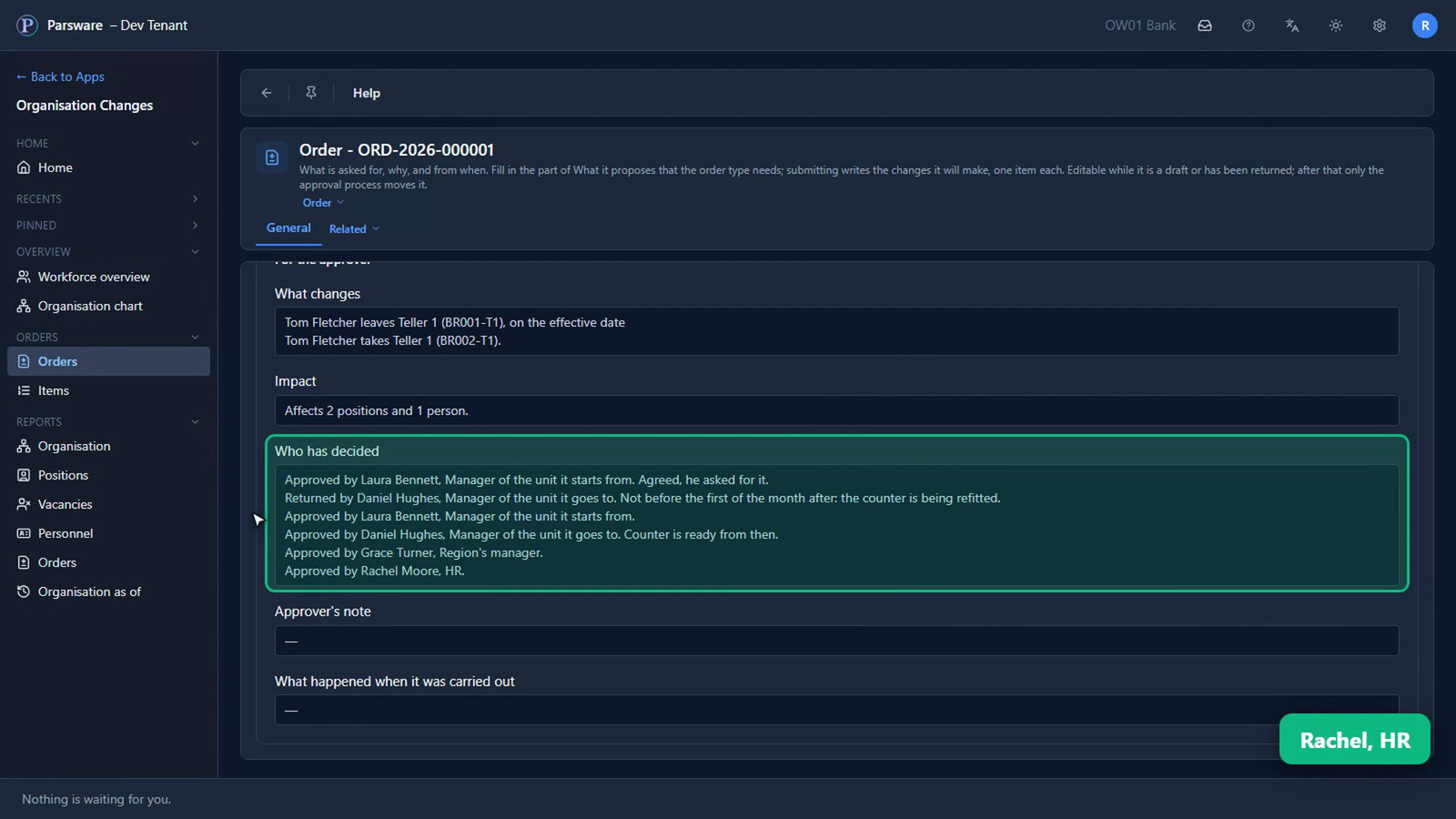
How the record is kept is in Every change, on the record.
Send this to someone evaluating a software proposal. And if your business has a problem nobody has solved yet, tell us about it.