3 ways to make your next app easier to maintain
Want to avoid an expensive rewrite later? Keep the app focused, organise its information and rules clearly, and make the things that change often into settings.
An application is cheapest on the day it goes live. After that, every change costs something, and the decisions made at the start decide how much. A well-made app absorbs years of small changes; a badly made one needs rewriting after two.
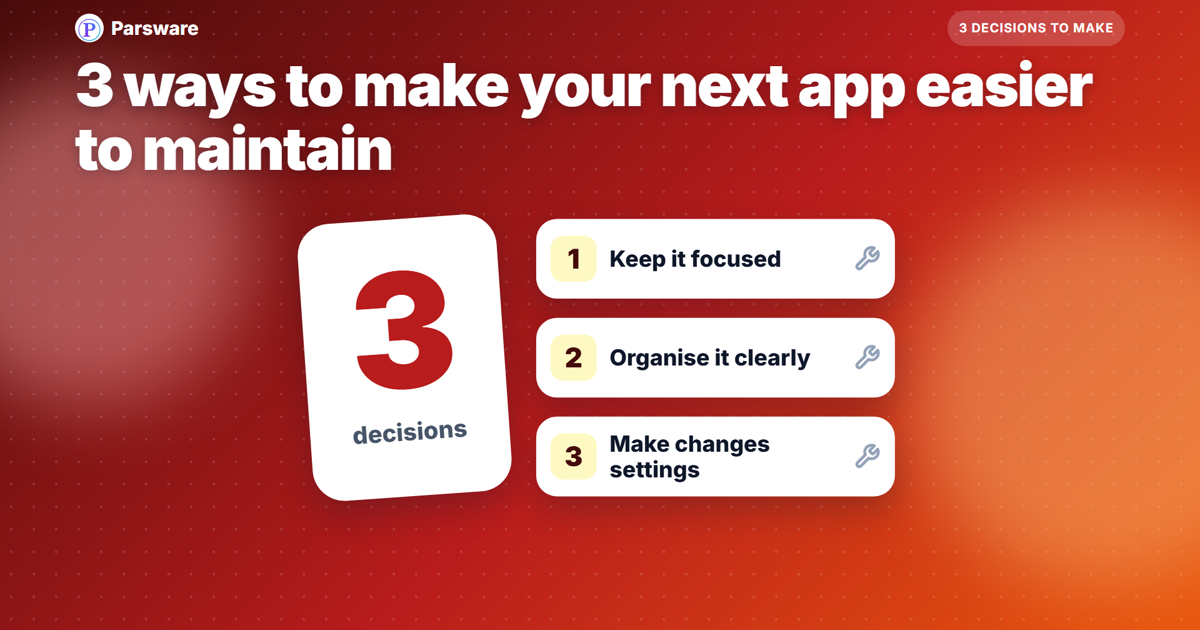
Three decisions, made early, make the difference.
1. Keep the application focused
Every screen, field and feature is something to keep working: to test after each change, to explain to new staff, to carry into the next version. An app that does one job well has less to maintain than one that does twelve jobs adequately.
In practice: for each proposed feature, ask which problem it solves and who will use it. If nobody can say, leave it out. It can be added later if someone needs it; removing it after people depend on it is much harder.
2. Organise business information and logic clearly
Maintenance gets expensive when nobody can tell where a rule lives. A price worked out in one screen, a limit checked in another, a total calculated differently in a report: every change becomes a search.
In practice: keep each kind of thing in its own place. Information in tables, with one record for each customer or order. Steps in a process. Rules where they can be found and read. Reports that read the data rather than recalculating it.
3. Make frequently changing elements configurable
Some things change all the time: prices, approval limits, who approves what, the text of a reminder. If each lives in code, each change is a development task. If each is a setting (a record in a table that the right person can edit) the business changes it itself.
In practice: list what changed in your current system over the last year. Those are the candidates. Not everything should be configurable, but the things that change often should be.
A business cost, not a technical one
Maintainability is a business-cost issue, not just a developer concern. It decides how quickly the business can change, and what each change costs. It is worth asking about before any project starts.
Where Parsware fits
Parsware is an app platform designed with this in mind. Forms, processes and reports are built in designers rather than written as code, information lives in tables, and rules can be records the business edits. AI is built into the designers, and we build custom mobile apps for iOS and Android.
Here is the third idea in our Capital planning sample application, a fictional company's budgets and approvals (sample data, not a customer). Who approves a request is not written into the app: it comes from the budget line and the approval limits, which the finance team edits:
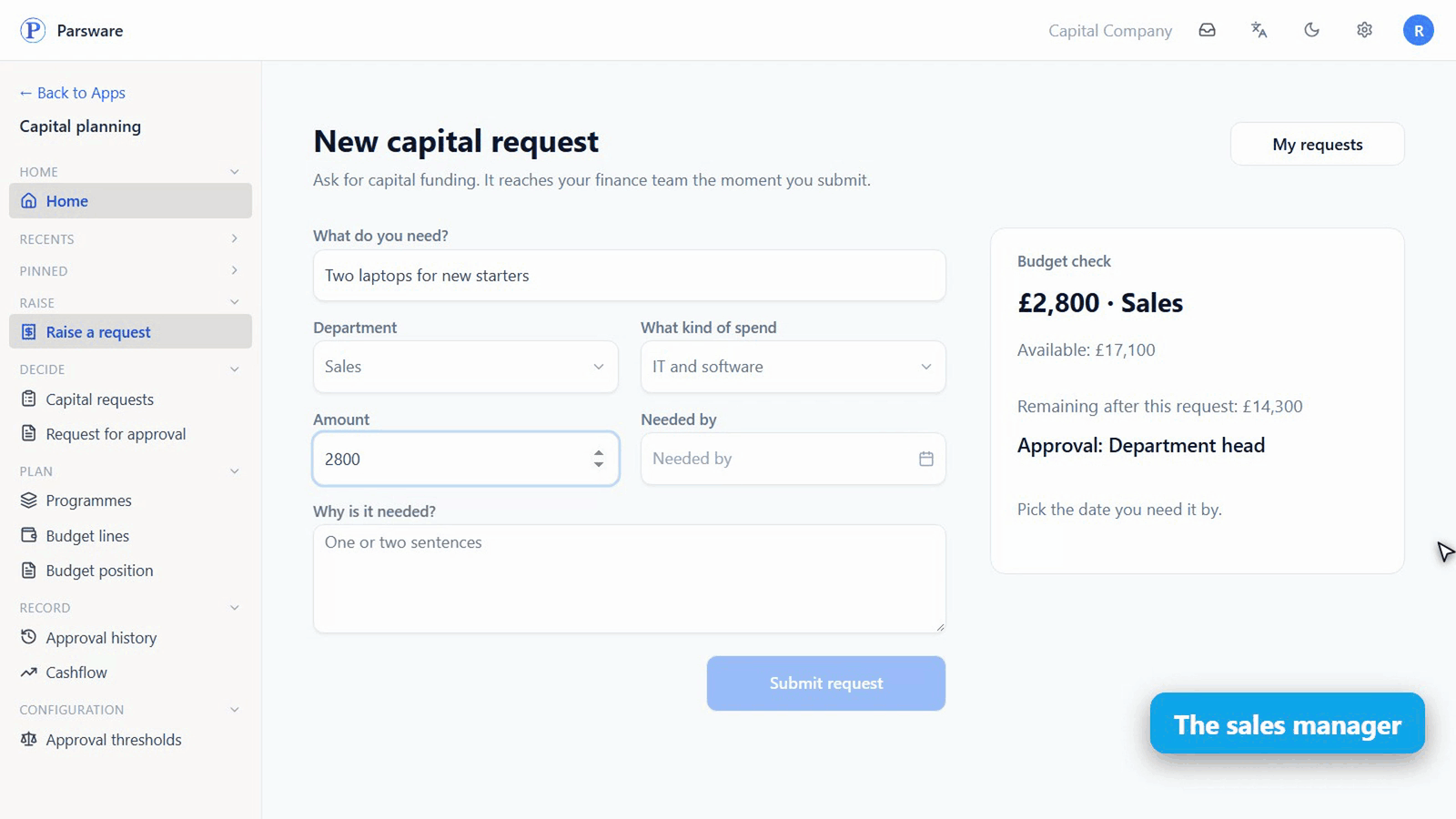
How the request works this out is in Ask for it once, with the answer on screen.
Save this checklist for your next app project. And if your business has a problem nobody has solved yet, tell us about it.