3 things to consider before building your next app
Planning a new app for your business? Before the first feature list, answer three questions: who will actually use it, what problem it must solve, and how the business might change.
Most app projects begin with a list of features. It is the natural place to start: features are concrete, easy to discuss, and easy to compare between suppliers. But a feature list answers the question what should it do? before anyone has answered the questions that decide whether it should do anything at all.
Three questions are worth answering first.
1. Who will actually use it?
Not "the staff" or "our customers", but the actual people: the front desk, the warehouse team, the manager who approves things on the train, the customer booking at eleven at night. Each of them uses an app in a different place, on a different device, with a different amount of patience.
Write down, for each kind of person, three things: where they are when they use it, what they need to get done, and what they need to see to do it. Those three lines shape the app more than any feature list.
2. What business problem must it solve?
Say it in one sentence. "Courts are double-booked about once a week." "Nobody knows what has been spent against the budget until the month closes." "Approvals take a week because they live in email."
If the problem can't be said in a sentence, the app will try to solve several problems at once and solve none of them well. If it can, every feature can be tested against it: does this help solve the problem, or is it just nice to have?
3. How might the business change over the next few years?
The first version of an app is built for the business as it is today. It will be used by the business as it becomes: more sites, more staff, a new product line, new rules. The question is not to predict everything, but to know which changes are likely, and to make sure they will be adjustments rather than rebuilds.
A useful exercise: list the three changes most likely in the next three years, and ask of any approach what each would cost.
People and problem first
Start with the people and the problem, not a list of features. The features still matter, but they follow from the answers above, and they are much easier to agree on once those answers are written down.
Where Parsware fits
Parsware is an app platform for building applications around those answers. Forms give each kind of person the fields they need, processes carry the work between them, and reports are drawn on a canvas. Because these are built in designers, the changes you listed in step three are edits rather than rebuilds. AI is built into the designers, and we build custom mobile apps for iOS and Android.
Here is the first question answered in our Sports & Leisure sample application, a fictional leisure business (sample data, not a customer). The front desk signs in and sees what the desk needs (customers, bookings, the till) and not the club's finances:
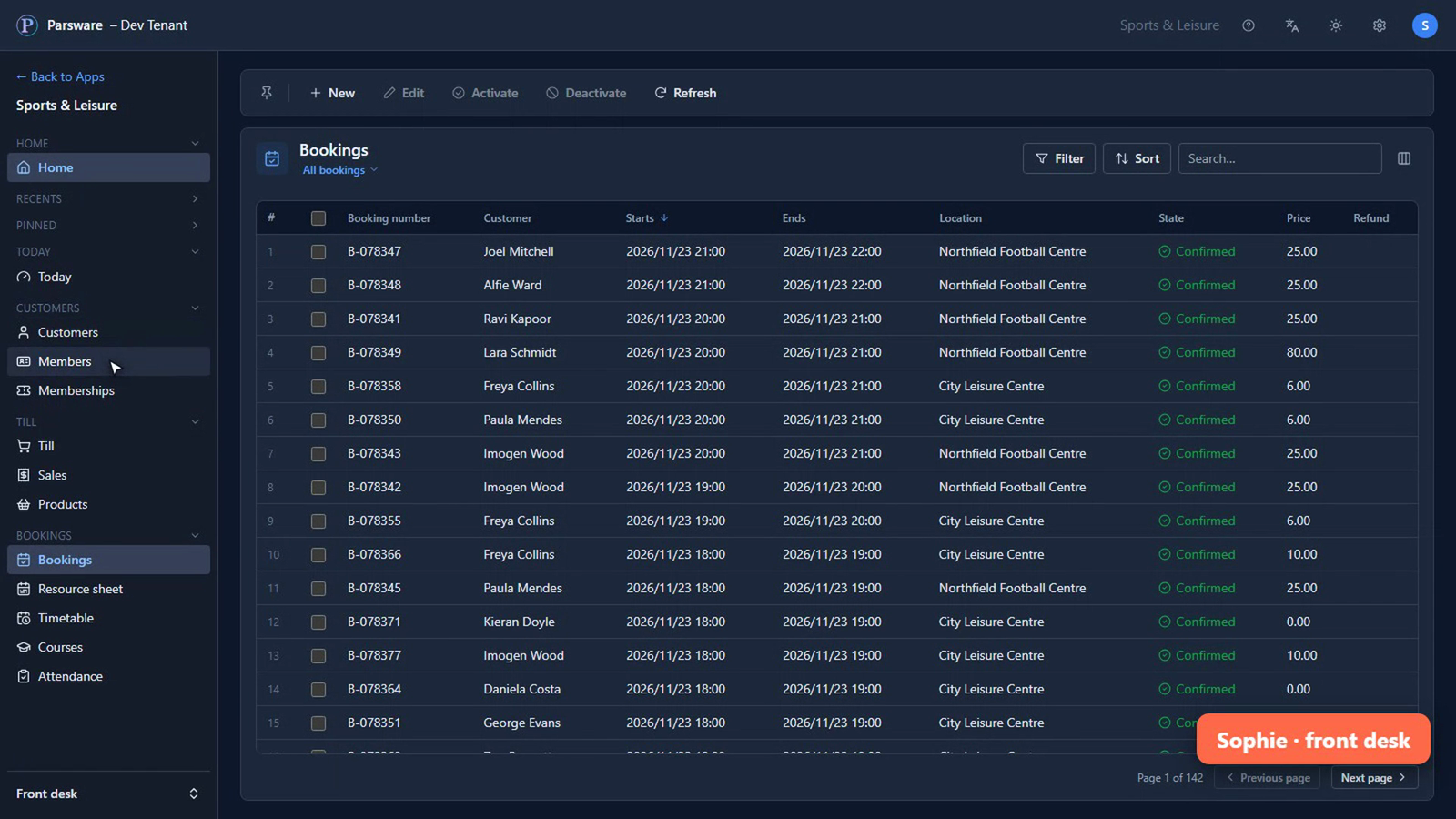
How each role gets its own view is in Everyone sees their own job.
Save this before starting your next software project. And if your business has a problem nobody has solved yet, tell us about it.