3 habits to stop when managing business data
Duplicate records in different places, the same information typed again and again, and decisions made from last month's report. Three habits that cause most data trouble, and how to break them.
Business data rarely goes wrong all at once. It goes wrong one copy, one re-typed field and one stale report at a time, until nobody is quite sure which numbers to trust.
Three habits cause most of that trouble. They are common because each one is the quickest way to get a job done today.
1. Keeping duplicate records in different places
The same customer appears in the membership spreadsheet, the phone list, the mailing list and the front desk's notebook. Each copy was made for a good reason. Over time they drift: a new phone number in one place, a misspelled surname in another, an email address that stopped working last year.
The cost shows up when someone needs the truth. Which address do we send the invoice to? Is this one customer or two?
Break it: decide that each customer, product or order has one record, in one place, and that everything else refers to it rather than copying it.
2. Re-entering the same information repeatedly
Related, but not the same: the same details typed into the order form, then the spreadsheet, then the invoice. Three times, three chances to slip, and three times the work.
Re-entry often survives because the tools don't talk to each other, so a person becomes the connection between them.
Break it: trace one piece of information from where it first arrives to everywhere it ends up. Every place it is typed by hand, rather than passed on, is a step to remove.
3. Making decisions from outdated reports
A report prepared last month, or last week, describes the business as it was. Decisions made from it are about a business that has already moved on: stock that has since sold, a customer who has since paid, a problem that has since grown.
Outdated reports are usually a symptom of the first two habits: when data lives in many copies, producing a current report means gathering and reconciling them, so it isn't done often.
Break it: for the few decisions that matter most, ask for the report to come straight from the live data, so it is current whenever it is opened.
One record, everywhere
Better organised information reduces confusion and improves visibility. The three habits are connected, and so are the fixes: one record for each thing, entered once, with reports that read from it directly.
Where Parsware fits
Parsware is an app platform built around exactly that. Tables hold one record for each customer, order or member, linked to the records they belong to. Forms capture the information once, processes pass it on, and reports, drawn on a canvas, read straight from the data so they are current when opened. AI is built into the designers, and we build custom mobile apps for iOS and Android.
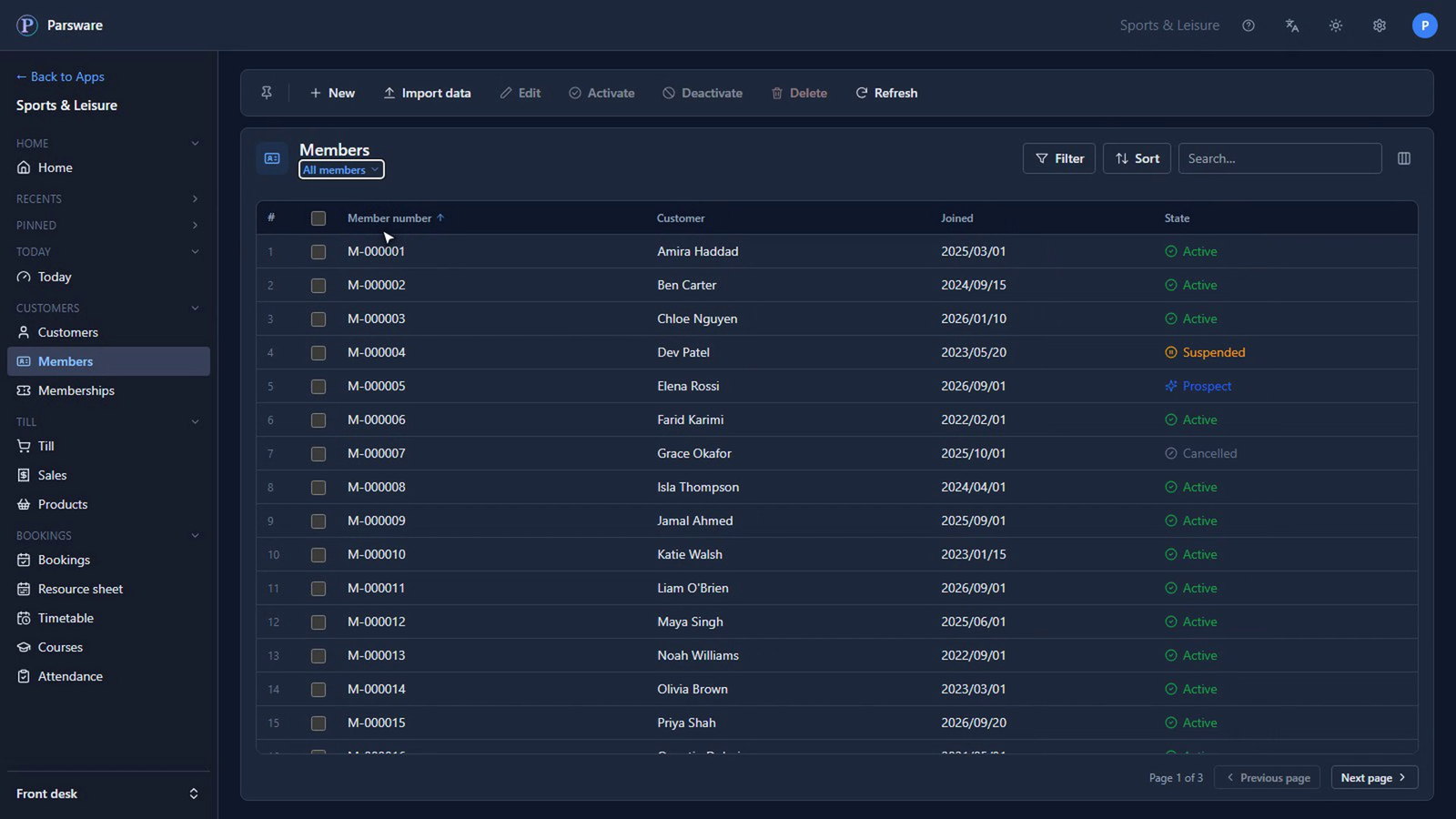
Here is the first habit broken in our Sports & Leisure sample application, a fictional leisure business (sample data, not a customer). Every member is one record, with their membership number, the date they joined and their current state, in one list:
How memberships and their entitlements work is in Who's a member, and what do they get?
Which of these habits causes the biggest headache in your business? And if it has a problem nobody has solved yet, tell us about it.