3 questions to ask before investing in business software
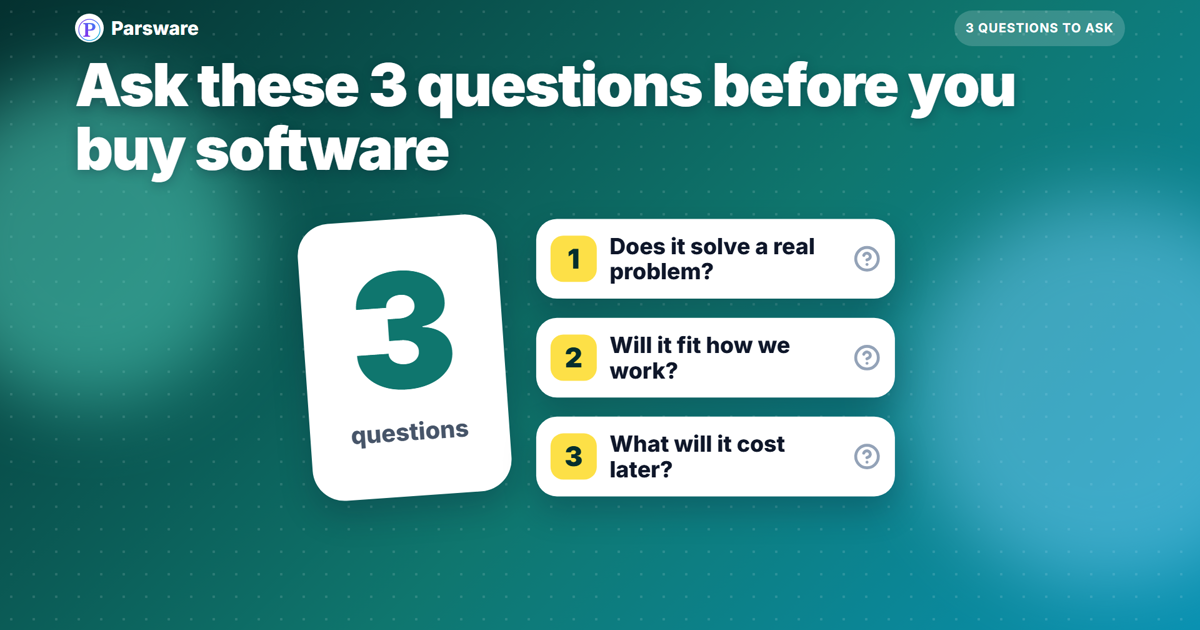
Before you spend money on business software, ask: does it solve a real problem we have today, can it adapt to how we work, and what will it cost to run and change over time?
Buying business software is a bigger decision than it looks. The price is visible, but the real investment is the team's time learning it, moving data into it, and working around it if it doesn't fit. Three questions, asked before signing, prevent most of the regret.
1. Does it solve a real problem we have today?
Not a problem we might have one day, or a problem the product is good at solving. A problem the business has now, that somebody can describe in a sentence: orders get lost between sales and the warehouse; nobody knows which customers are behind on payments; approvals take a week.
If the problem can't be described that simply, it is worth stopping to describe it first. Everything else (the demonstration, the features, the price) only makes sense against it.
A good sign: you can name the person whose working day gets better, and how.
2. Can it adapt to the way our business works?
Every business has its own rules: how it prices, who approves what, what happens when something is cancelled. Some software adapts to them. Other software expects the business to adapt to it.
Adapting to software is not always wrong; sometimes the software's way is better. But it should be a decision, not a surprise discovered after go-live.
A good test: take two or three of your real rules, the awkward ones, and ask to see them set up. Not described: set up.
3. What will it cost to operate and maintain over time?
The purchase price is the first cost. Then come licences that grow with the team, someone to keep it running, updates, and the cost of every change the business will need over the years.
Three things are worth asking directly:
- Maintenance: who keeps it running, and what does that cost each year?
- Change: what does a new field, a new step or a new rule cost, and who can make it?
- Your data: can you get all of it out, in a usable form, if you leave?
The price is only one part
The purchase price is only one part of the decision. The cheapest option on day one can be the most expensive by year three, and the reverse. Asking all three questions of every option, including the one you already have, makes the comparison fair.
Where Parsware fits
Parsware is one option to evaluate, and not the right answer for every company. It is an app platform where forms, processes and reports are built in designers around your business's own rules, so a change is an edit rather than a project. AI is built into the designers, and we build custom mobile apps for iOS and Android.
Here is the second question answered in our Sports & Leisure sample application, a fictional leisure business (sample data, not a customer). Its prices follow the club's own rules (members and non-members, weekdays, peak evenings and weekends) set up as records the club can edit:
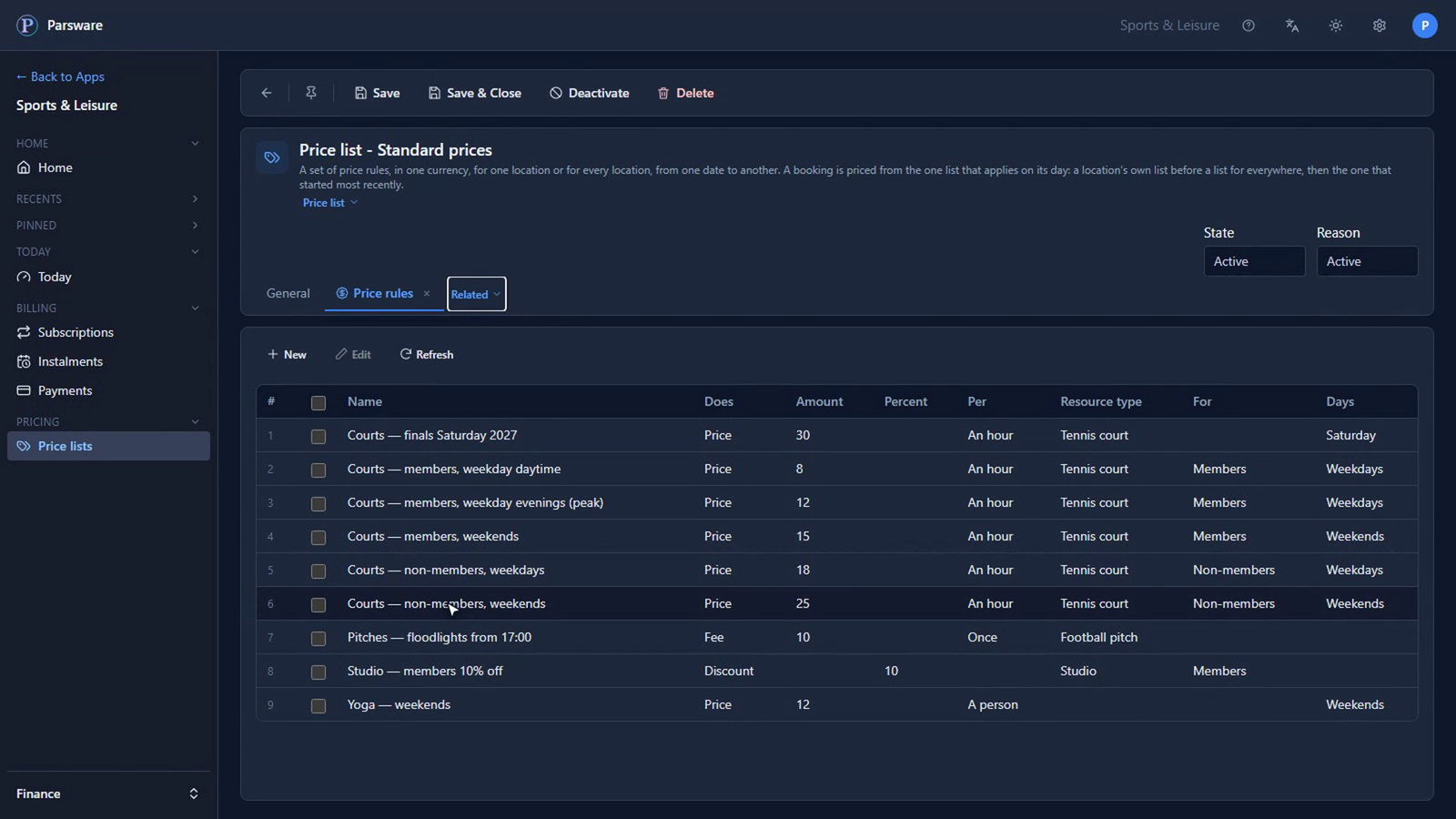
How each booking's price is worked out is in Prices that work themselves out.
Which of the three questions do businesses forget most often? And if your business has a problem nobody has solved yet, tell us about it.