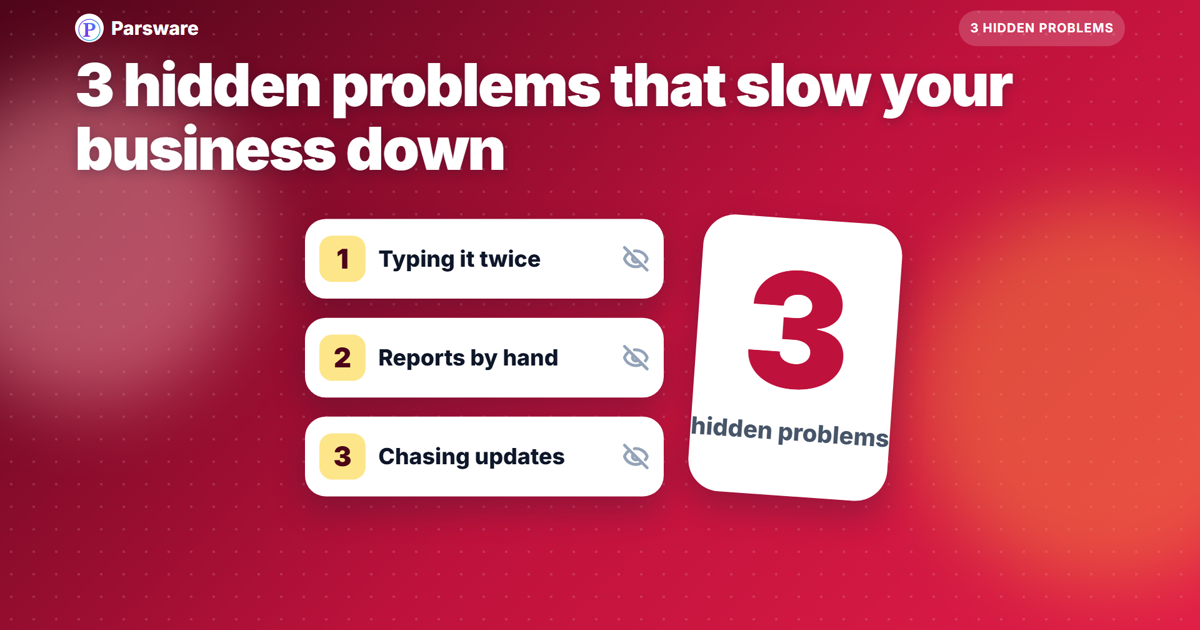
3 hidden problems that slow a business down
Typing the same thing twice, building reports by hand, chasing updates across messages. Nobody measures them, so nobody fixes them. Here is how to spot each one, and what to do about it.
Most businesses know where their big costs are: rent, salaries, stock. The time that leaks away in small pieces is harder to see, because nobody records it. Nobody's timesheet says "forty minutes re-typing an address" or "an hour finding out where an order is".
Here are three of the most common leaks. Each is small on its own; together they can take a real share of every week.
1. Entering the same information more than once
A new customer's details are typed into the order spreadsheet. Then into the invoice. Then into the delivery note, and into somebody's address book. Four copies of the same facts, typed by hand.
The time is only half the cost. Every copy is a chance for a slip, and copies drift apart: a phone number updated in one place and not the others, a name spelled two ways, an invoice sent to last year's address.
How to spot it: pick one customer or order and count how many places it is typed into. If the answer is more than one, the information is being entered more than once.
2. Preparing reports by hand
Every Monday somebody exports a list, pastes it into a spreadsheet, fixes the columns, adds the totals, and emails it round. It takes an hour or two, it is out of date by Wednesday, and if that person is away there is no report.
Manual reports also shape what gets measured. If a figure is tedious to calculate, it simply is not reported, and decisions are made without it.
How to spot it: list the reports people receive regularly and ask who prepares each one, and how. Any answer that starts with "I export…" is a manual report.
3. Chasing updates across departments and messages
"Any news on this?" sent to three people. A call to the warehouse to ask where something is. An email thread with "Re:" four times in the subject. Each is a person stopping their own work to find out the state of somebody else's.
Chasing happens when the state of the work lives in people's heads and inboxes rather than in one place everyone can look at.
How to spot it: count how often in a week someone asks "where is…?" or "has anyone…?". Each one is a status that could have been visible.
Small leaks add up
None of these will appear on a profit-and-loss statement, which is exactly why they last. The fix is rarely dramatic: enter information once, let reports come from the data rather than from a person, and make the state of the work visible to the people who need it.
Before changing anything, it is worth measuring roughly: how many times is data re-typed, how many hours go into reports, how many "where is it?" messages a week. That gives you something to compare against afterwards, rather than a promise.
Where Parsware fits
Parsware is an app platform for putting the work in one place. A form captures information once, and every screen and document reads from that one record. Processes move work from step to step so its state is always visible, and reports are drawn on a canvas and fill themselves from the data. AI is built into the designers, so a report can start from a sentence, and we build custom mobile apps for iOS and Android so updates come from where the work happens.
Here is the third leak answered in our Organisation sample application, a fictional organisation's structure and personnel changes (sample data, not a customer). The workforce overview shows vacant positions, temporary positions, people without a seat and changes on their way, the questions people used to ask HR:
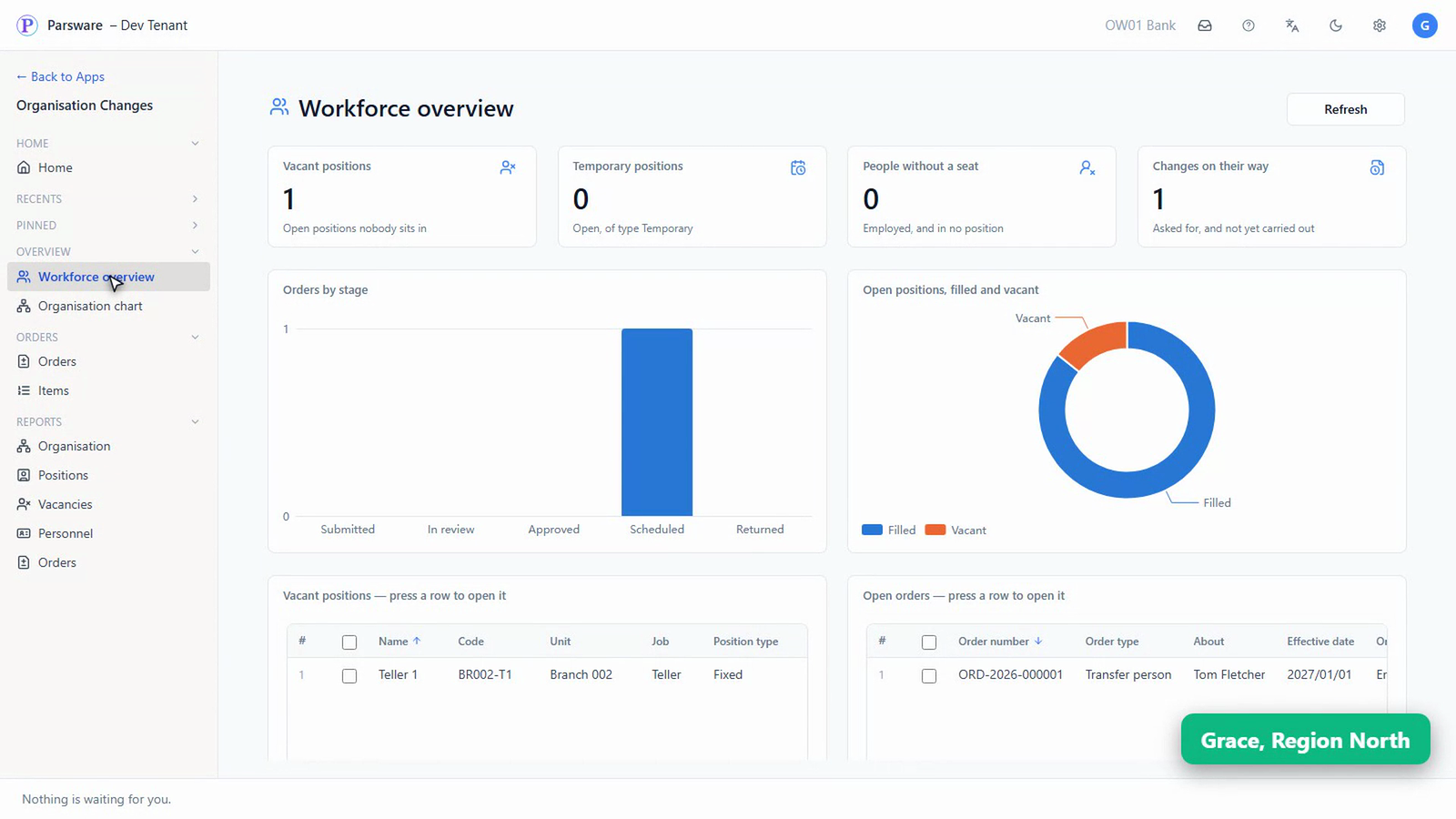
The whole page is explained in Headcount and vacancies, without asking HR.
Which hidden time-waster costs your team the most? And if your business has a problem nobody has solved yet, tell us about it.