3 questions every business owner should be able to answer
Where does the business make its money? Where do time and resources go? What is slowing it down? If the honest answer to any of them is a feeling, here is how to turn it into something you can see.
Ask a business owner how things are going and you will usually get a confident answer. Ask how they know, and the answer often gets vaguer: a sense from the bank balance, a feeling from the busy days, what the team said in the last meeting.
A feeling is not nothing. But there are three questions every owner should be able to answer with something firmer, and most can only answer one of them.
1. Where does the business make its money?
Not the total: the where. Which products or services bring in the most, which customers, which locations, which months. A business that sells ten things rarely earns equally from all ten, and the difference is usually larger than people expect.
Without that answer, effort goes where it always has. The loudest customer gets the attention, the product somebody likes gets the shelf space, and the quietly profitable line is left to look after itself.
What good looks like: you can say, without opening three spreadsheets, which products, customers and places carry the business, and how that has changed since last year.
2. Where are time and resources being spent?
The second question is the other side of the first. Money comes in somewhere; time, people and spending go out somewhere else. Are they going to the same places?
This is harder to answer because time is rarely recorded. Hours spent re-typing orders, preparing reports or chasing approvals do not appear on any invoice. They show up as a team that always seems busy, and a sense that growth needs more people than it should.
What good looks like: you know roughly how many hours each important process takes, who does it, and what each team spends, so you can tell whether effort matches where the money is made.
3. What is slowing the business down?
Every business has a step where work waits. An approval that sits in somebody's inbox, a quote that needs one person's sign-off, a delivery that cannot leave until a form is filled in. Nobody designed the bottleneck; it grew.
You find it by following one piece of work from start to finish and noting each time it stops. Usually it is not one dramatic delay but the same small wait, repeated hundreds of times a month.
What good looks like: you can name the step where work most often waits, and you can see how many items are waiting there right now.
A feeling, or knowing?
Owners need to see the business, not just feel that things are going well. The three answers are worth writing down even on paper: it is the first step to deciding what to measure, and which numbers you would want on one page every morning.
The difficulty is that the answers usually live in people's heads and scattered files. That is the part an application can fix: when the work itself goes through one system, the answers come out of it as a by-product instead of a project.
Where Parsware fits
Parsware is an app platform for building that system around your own operation. Forms record the work as it happens, processes carry each request through its approvals, and reports are drawn on a canvas so the answers look the way you want to read them. AI is built into the designers, so a first draft of a report can start from a sentence, and we build custom mobile apps for iOS and Android when the work happens away from a desk.
Here are the first two questions answered for spending in our Capital planning sample application, a fictional company's budget and approvals (sample data, not a customer). One report shows every budget line with what is committed, what is spent and what is left:
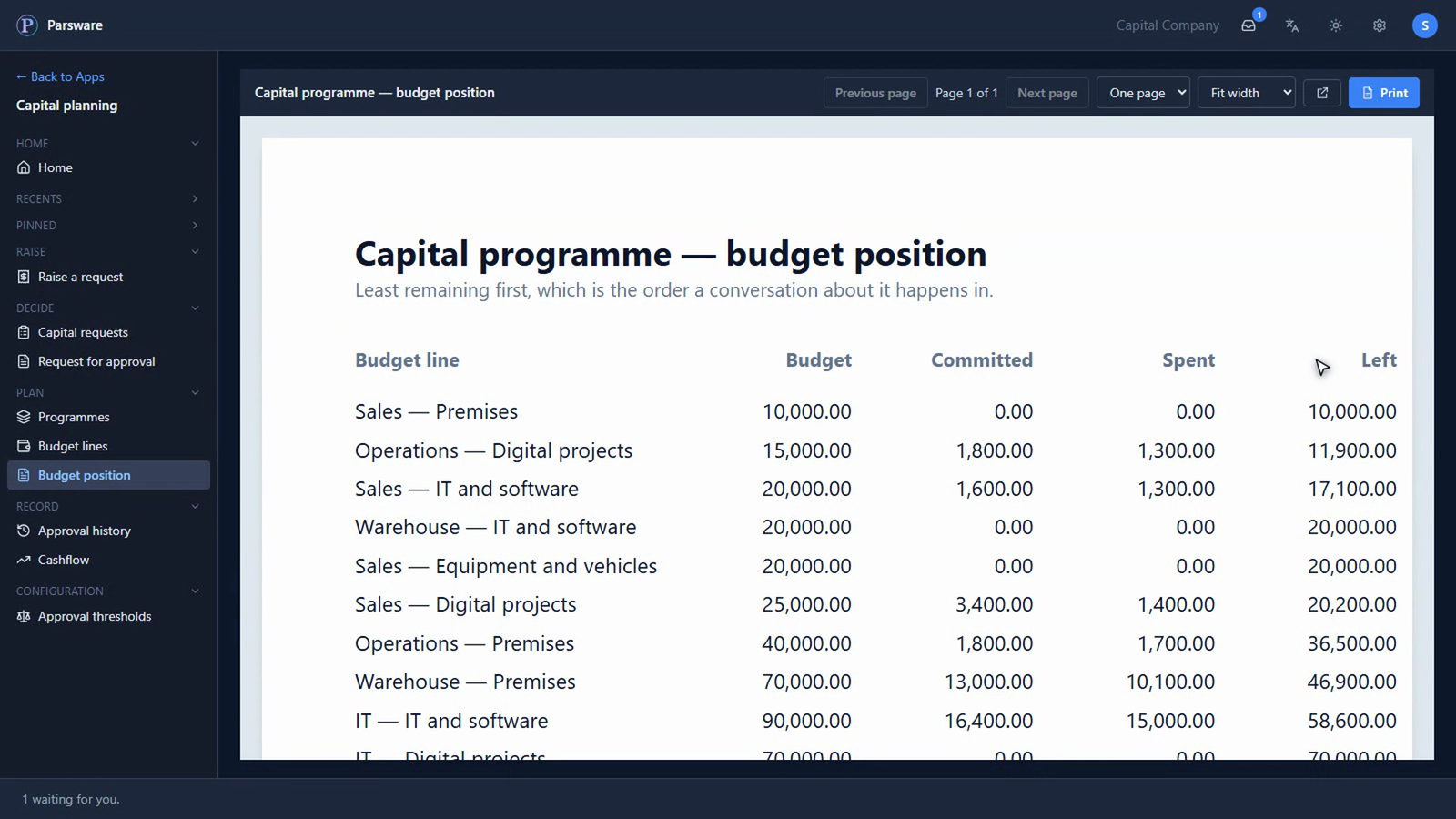
How that report is built, and how it stays current, is in Where the budget stands, before the meeting.
Which of the three questions is hardest for you to answer? And if your business has a problem nobody has solved yet, tell us about it.