3 traps to avoid as your business grows
As a business grows, three operational traps appear: systems that drift apart, processes only one person knows, and decisions made with numbers that don't agree.
Growth is the goal, but it brings its own problems. Things that worked with a small team start to strain, slowly enough that nobody notices until something goes wrong. Three traps are especially common.
1. Letting important systems become disconnected
As a business grows, each team solves its own problems: sales gets a list, accounts gets a package, support gets an inbox, the warehouse keeps a log. Each choice is sensible. Together they create a business whose information is split across systems that don't talk to each other.
The cost shows up as re-typing, as mismatched records, and as questions that need three teams to answer.
Avoid it: before a team adds a new system, ask what information it shares with the others, and how that information will stay consistent.
2. Allowing essential processes to depend on only one person
"Only Kate knows how that works." In a small business, it sounds like praise. As the business grows, it is a risk. When Kate is ill, on holiday or leaves, the process stops, and nobody knows quite what she did.
Avoid it: for each essential process, ask: if this person were away for two weeks, could someone else do it? If not, write the process down, and put the information it depends on where others can find it.
3. Making decisions with inconsistent information
Sales says 120 orders, finance says 104. Both are right by their own definitions, and the meeting spends its time reconciling them instead of deciding.
Avoid it: agree one definition for each important number, and produce it from one place, so that everybody looks at the same figure.
Shared and visible
Growth needs clear processes and shared visibility. None of the three traps is caused by growth; growth only reveals them. They are easiest to fix before the business is twice the size.
Where Parsware fits
Parsware is an app platform for bringing related information and tasks together. Tables hold one record for each customer or order, processes make essential steps visible rather than personal, and reports drawn on a canvas give everyone the same numbers. AI is built into the designers, and we build custom mobile apps for iOS and Android.
Here is the second trap avoided in our sales sample application, a fictional company's leads and customers (sample data, not a customer). Every call to a contact is on their timeline, so the history of a relationship is on the record, not in one salesperson's head:
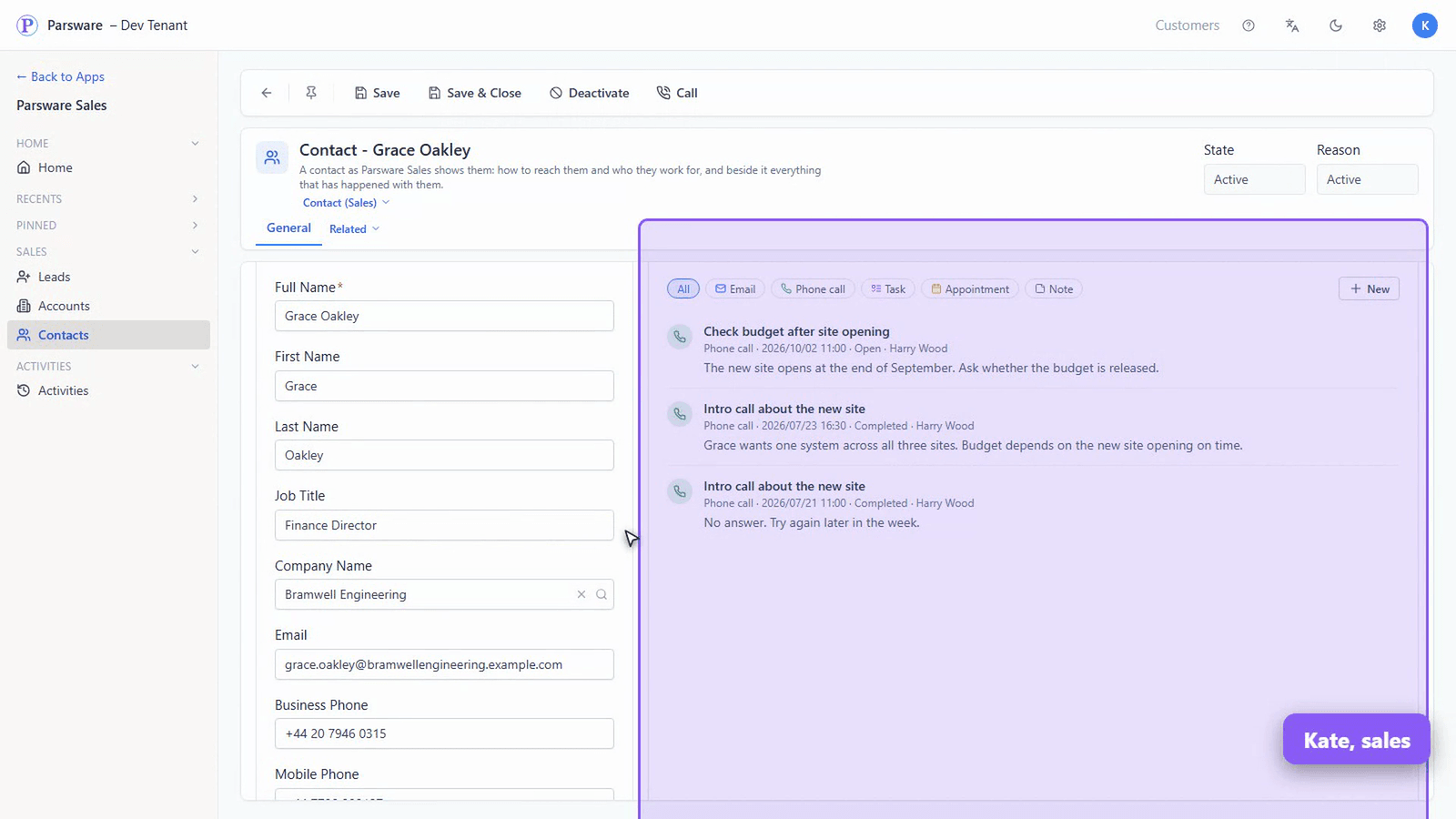
How the timeline is kept is in Which salesperson spoke to them last?
Which of these risks do you recognise? And if your business has a problem nobody has solved yet, tell us about it.