3 practical steps to a more efficient business
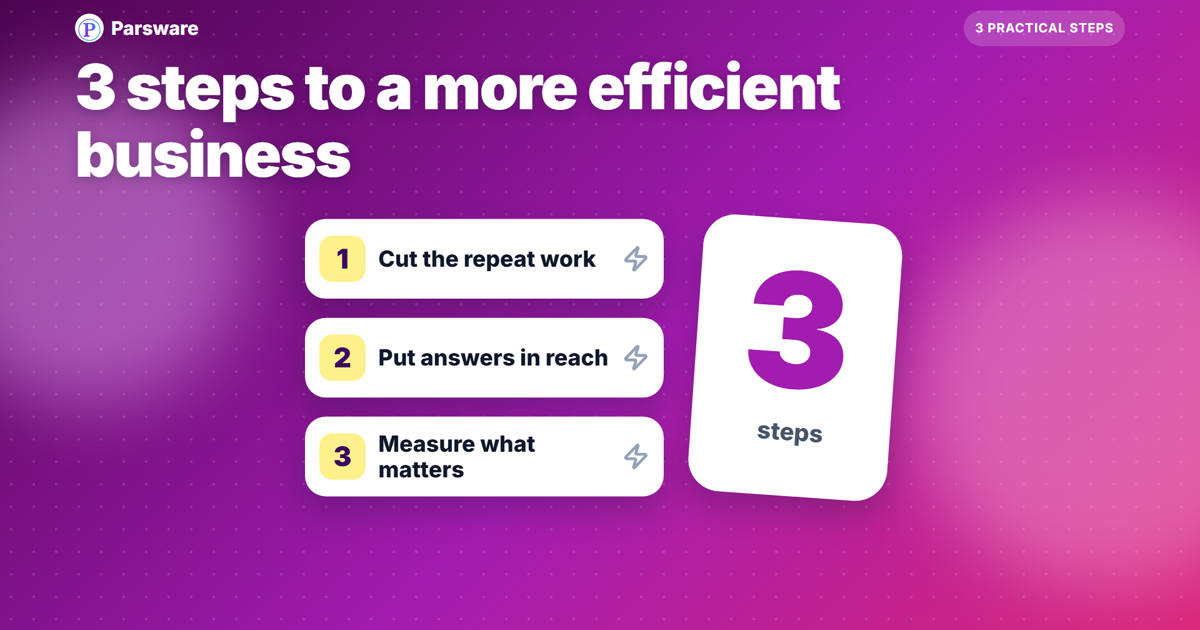
Efficiency rarely comes from working faster. It comes from cutting repeat work, putting information within reach, and measuring the processes that matter. Here is where to start with each.
"We need to be more efficient" is one of the most common things said in a business, and one of the least specific. It often turns into asking people to work faster, which rarely lasts.
The gains that last come from changing how the work is done. Three steps are a good place to start, and none of them needs a big budget to begin.
1. Reduce repetitive manual work
Look for anything done by hand more than once a week: the same details typed into several places, the same email sent to the same people, the same list copied into the same spreadsheet. Repetitive work is slow, it is where mistakes creep in, and it is the work people least enjoy.
Where to start: ask each team to list the three tasks they repeat most often. The overlaps between the lists are usually the best candidates. The aim is simple: enter information once, and let the system pass it to everyone who needs it.
2. Make important information easier to access
A surprising amount of time goes into finding things out: the latest price, whether an order has shipped, which version of a document is current. When the answer lives with one person, everyone else waits for them.
Where to start: note the questions people ask each other during a normal week. Each one that comes up repeatedly is information that should be visible without asking, on the screen where the person already works.
3. Measure the processes that matter
You can't improve what you can't see. Pick the few processes that matter most to customers or to cash (orders, bookings, approvals, payments) and measure something simple about each: how many are waiting, how long they take, how many go wrong.
Where to start: choose one process and one measure, and look at it every week. The first few weeks often show the problem more clearly than any meeting would.
Less chasing, less repeating
Efficiency improves when people spend less time chasing information and repeating tasks. None of the three steps is about technology first. They are about noticing where effort goes. Technology helps once you know what you want it to do.
Where Parsware fits
Parsware is an app platform for building applications around your own processes. A form captures information once, processes move the work between people and do the repeat steps for them, and reports drawn on a canvas show how each process is doing. AI is built into the designers, so a first draft can start from a sentence, and we build custom mobile apps for iOS and Android.
Here is the first step in our Sports & Leisure sample application, a fictional leisure business (sample data, not a customer). When a member takes out a monthly membership, a year of payments is scheduled from that one record. Nobody types them in:

How the payments are taken and what happens when one fails is in Memberships that pay themselves.
Which process would you improve first? And if your business has a problem nobody has solved yet, tell us about it.