Stop making these 3 expensive technology decisions
The licence fee is the easy number. The expensive decisions are buying before the problem is defined, paying for features nobody uses, and forgetting what change will cost.
When a business buys software, the price is the number everybody looks at. It is rarely the number that turns out to matter. The expensive part usually comes from decisions made before and after the purchase, and three of them come up again and again.
1. Buying software before defining the problem
It usually starts with a demonstration. The product looks capable, the price seems fair, and a problem that was vaguely felt suddenly has a solution. Six months later the team is back in the spreadsheet, because nobody wrote down what the problem actually was.
A problem definition does not need to be long. One page is enough:
- What goes wrong today, in concrete terms: what is late, lost, repeated or unclear.
- Who it affects, and what they need to do their job.
- How you would know it is fixed: what would be faster, visible or no longer needed.
With that page in hand, every product, demonstration and quote can be judged against it.
2. Paying for features the team will not use
Software is often sold by the module and the seat. Forty modules when the team uses four, two hundred licences when sixty people sign in, a premium add-on bought for one report. Each made sense in the meeting where it was agreed.
Unused features cost more than their price. They clutter the screens people do use, they need configuring and updating, and they make the system harder to learn.
Before buying, ask: which features will we use in the first three months, and who will use them? Pay for those, and add more when somebody needs them.
3. Ignoring long-term maintenance and change costs
Businesses change: a new approval limit, a new product, a new branch, a new rule from a regulator. The question is what each change costs. In some systems it is a setting a manager edits. In others it is a change request, a quote and a release.
Over the life of a system, the cost of change often outweighs the cost of purchase. It is also the cost least likely to be discussed before signing.
Before buying, ask: what happened the last time a customer needed a rule changed? Who did it, how long did it take, and what did it cost? And can we get our data out if we leave?
Think about the whole life
A thoughtful buying decision considers actual use and the full lifecycle, not only the first invoice. Packaged products, custom builds and app platforms are all reasonable options; each suits different problems. The one-page problem definition and the three questions above work for all of them.
Where Parsware fits
Parsware is one option worth weighing: an app platform where the parts most likely to change are things a business can edit. Forms, processes (the approval steps) and reports are built in designers rather than written as code, so adding a field, changing a step or redrawing a report is a change rather than a project. AI is built into the designers, you build only what the work needs, and we build custom mobile apps for iOS and Android.
Here is a rule a business changes itself, in our Sports & Leisure sample application, a fictional leisure business (sample data, not a customer). The cancellation policy (how much notice, what is refunded) is a record the club edits, not code:
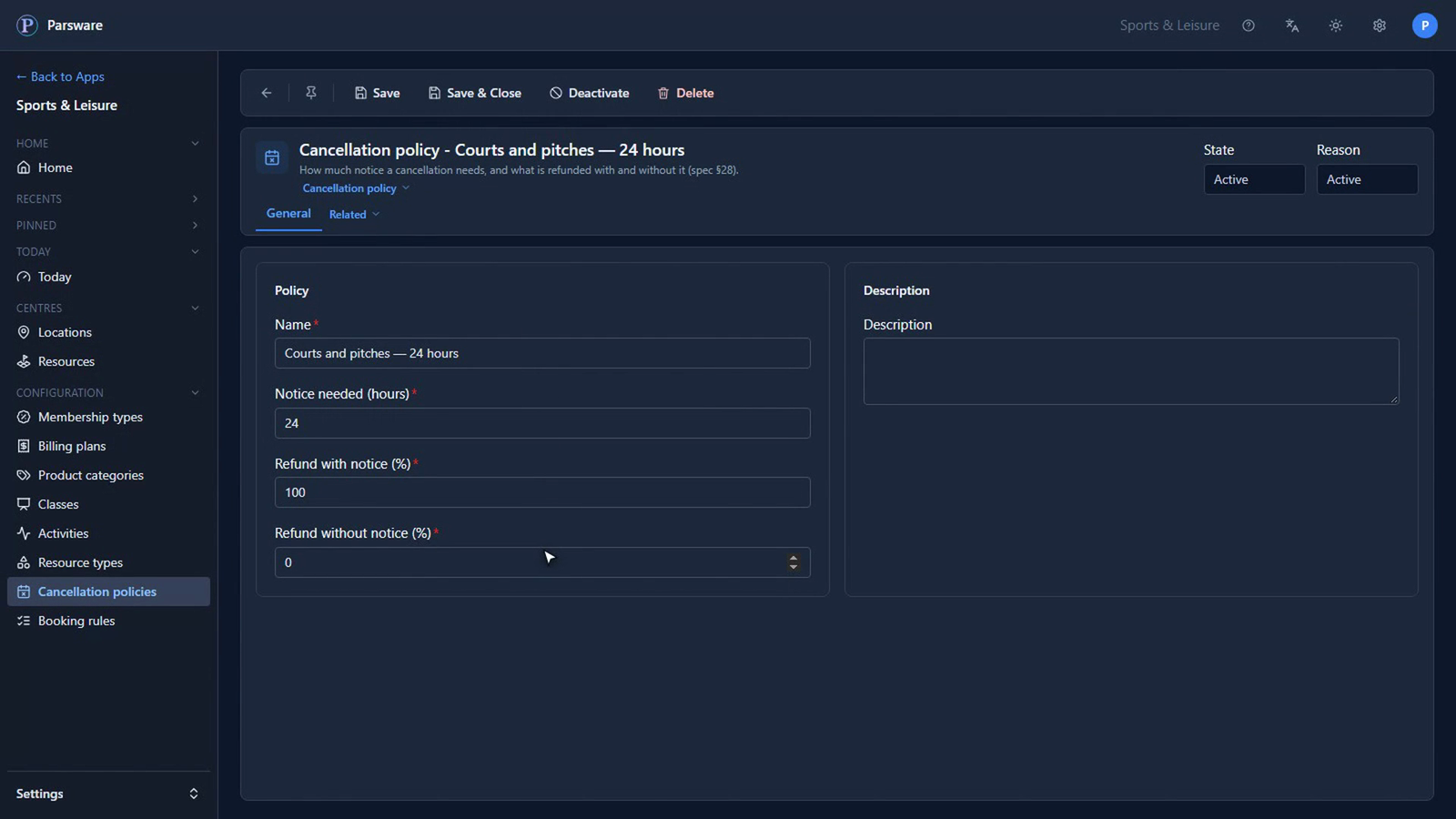
How the policy works out each refund is in Cancellations without arguments.
Save this before your next software purchase. And if your business has a problem nobody has solved yet, tell us about it.