3 signs your business might need its own app
At what point does a business need an application of its own? Three signs: too many disconnected tools, a process that is yours alone, and information that is hard to find.
Most businesses start with what is to hand: a spreadsheet, email, a chat group, a shared folder. That is the right choice when the business is small. The question is when it stops being the right choice, and the answer is rarely a single moment.
Here are three signs that a business may be ready for an application of its own. One on its own is worth watching; all three together usually mean the tools no longer fit the work.
1. Your team relies on several disconnected tools
Prices in one spreadsheet, bookings in another, approvals in email, updates in a chat group, files in a shared folder. Each tool is fine. The trouble is between them: information is copied from one to another by hand, and nobody has the whole picture.
You can tell when: a simple question ("is this customer up to date with payments?") needs two or three tools to answer, and someone to stitch the answers together.
2. Your processes are specific to your business
Generic software assumes a generic business. Yours probably isn't. Your approval limits, your pricing rules, the order in which things must happen, the exceptions everybody knows about: these are often what makes the business work.
When a packaged tool can't express them, people bend the process to fit the tool, or keep the real process outside it, in email and memory.
You can tell when: people say "the system can't do that, so we…" followed by a workaround.
3. Important information is difficult to find or understand
The data exists, somewhere. But finding it means asking the right person, and understanding it means knowing which version is current and how it was calculated.
You can tell when: the same question gets different answers from different people, or a report needs explaining before anyone trusts it.
What it means
When generic tools no longer fit the work, a tailored application is worth exploring. That does not have to mean a big project. Most businesses start with one process: the one with the most copying, the most workarounds, or the most questions. If it works, the next one follows.
Before talking to anyone, write down that one process: who does what, in what order, what rules apply, and what people need to see. That description is useful whichever way you go.
Where Parsware fits
Parsware is an app platform for building an application around your own operation. Forms ask for exactly the fields you need, processes carry your own approval steps and rules, and reports are drawn on a canvas. AI is built into the designers, so a first draft of a process can start from a sentence, and we build custom mobile apps for iOS and Android.
Here is the second sign answered in our Sports & Leisure sample application, a fictional leisure business with three sites (sample data, not a customer). Its resource sheet gives every court, lane and pitch its own column, and refuses a booking that would overlap another, a rule specific to that kind of business:
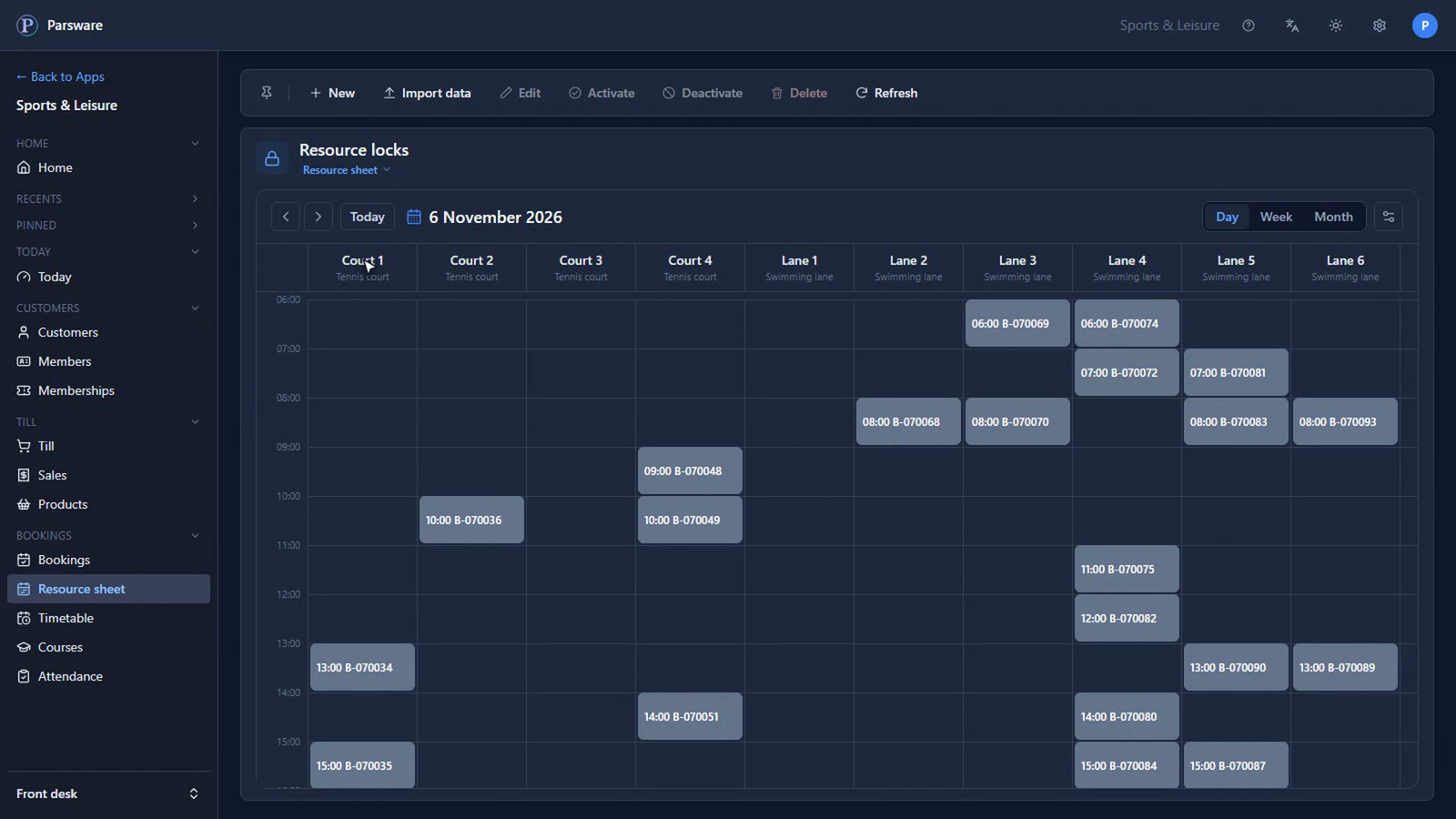
How the double-booking rule works is in Never double-book a court again.
Does your business run on one system, or several? And if it has a problem nobody has solved yet, tell us about it.